

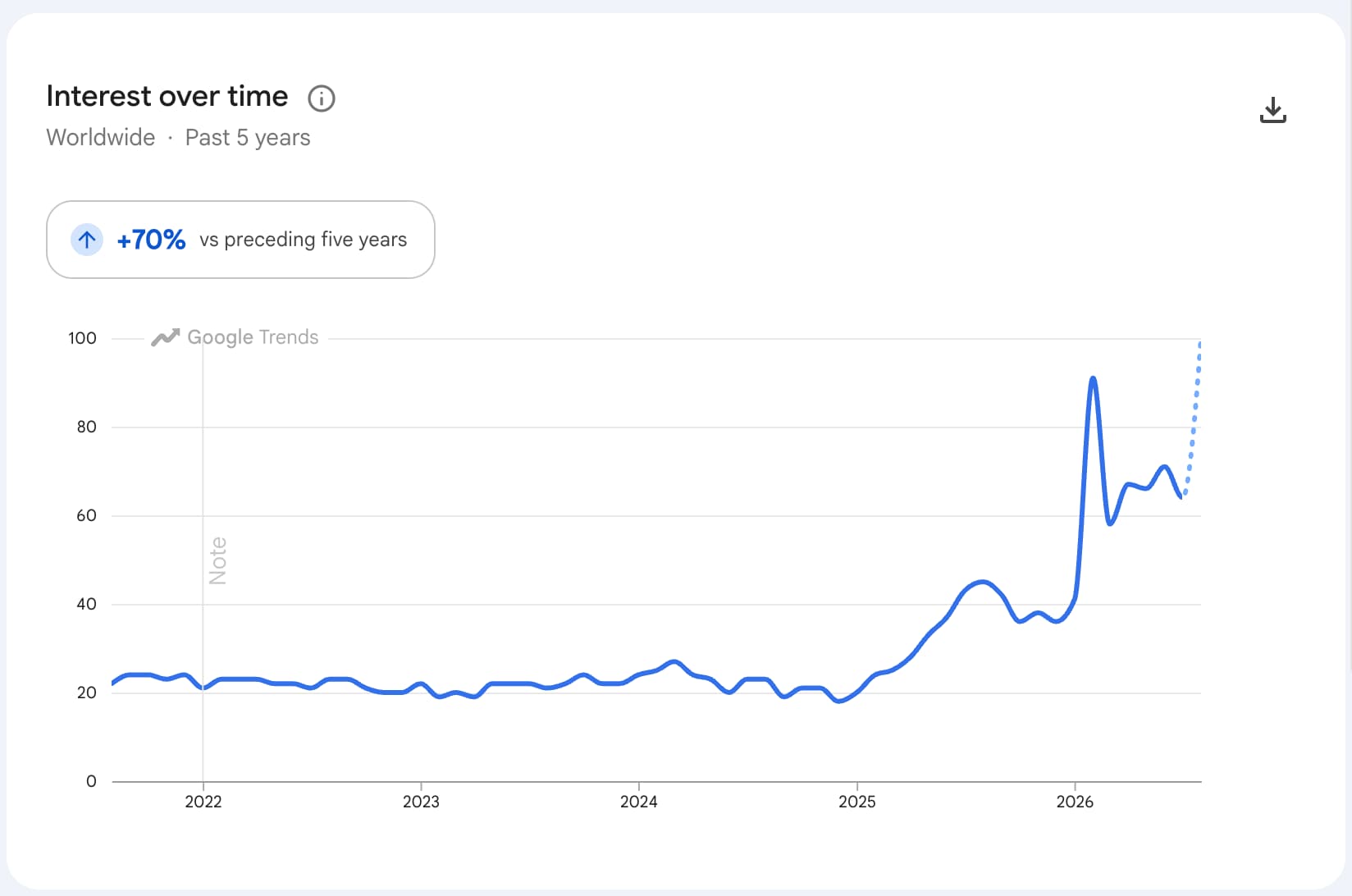
For the past decade, content marketing has taken a back seat and sat under the shadow of digital marketing. In the AI era however, we’re seeing it roar back into popularity like never before, as interest grew 70% versus the preceding five years.
Let’s face it, AI has commoditised content production. Your AI chatbot can now generate averagely written articles and scripts with such ease. As a result, previous digital marketing channels like email and SEO blogs have been flooded with AI automated content that is hurting everyone’s organic visibility.
When creating content becomes easy, simply filling up a content calendar is no longer the advantage it once was. In this age of AI, brands have to instead look at content strategically as a foundational layer that feeds paid media, SEO, AEO, email, social, events, and demand generation.
This renewed interest is already showing up in marketing budgets. According to the Content Marketing Institute’s 2026 B2B research, 32% of marketers plan to increase investment in owned media, including websites, blogs, email programmes and other content assets. That puts owned media ahead of paid media, which was selected by 25%.
More importantly, 65% of effective B2B marketing teams credited better content relevance and quality for improving their results. Only 43% attributed their gains to technology and tools.
The figures suggest that brands are not abandoning paid distribution or technology. Rather, they are investing more heavily in the content platforms and intellectual property they can control, reuse and compound over time.
This chase for more efficient growth pathways have also shifted the nature of content. Highly performing content has become even more opinionated, data-driven and storytelling-centered. Because in this era of AI, weak marketing moves get quickly punished especially when the stakes for growth have never been higher.
No More Bottlenecks

Having made content globally for close to a decade, here’s my best guess as to why demand for content marketing is soaring now as compared to five years ago. This boils down to how the “Product”, especially in software, is no longer the moat that it once was.
Thanks to the superhuman coding abilities of Claude Code and Codex, the once extensive costs of building out an engineering team to create software or tech products have remarkably diminished. Sparking the so-called SaaSpocalyse. Even the head of Claude Code, Boris, admits to not having written a new line of code in eight months.
In fact, software giants that were once the darlings of the market, have cratered in share price over the past year. Bain attributes the decline to a combination of AI disruption, slowing customer retention and an increasingly pronounced divide between likely winners and losers.
Instead of a technical bottleneck, startups and enterprises alike now face a different challenge, which is acquiring users cheaply and more efficiently. Naturally, this path leads to content marketing. With rising competition in advertising and paid media, one benchmark covering more than 16,000 campaigns found that average Google Ads cost per click rose by approximately 16% in 2025. As a result, companies no longer can rely on single-channel efforts to drive growth.
Even in-person connections made at a conference have to be nurtured over time. And content in the form of YouTube videos or newsletters, has become the necessary modern tool to not only nurture prospects, but also drive awareness and conversion alike.
Content now powers paid media efficacy, organic visibility via AI search engine optimisation, brand positioning, and more. It has also become an area where brands can differentiate themselves, with their creativity, viewpoint, and thought leadership. All these efforts are not simply replicable with a click of a button, as much as AI CMO software solutions want you to believe.
When executed well, content marketing is the difference between being chosen by customers even before a sales call and stretching your sales team thin, as they spend countless hours chasing down prospective customers and educating them one-to-one.
Gartner found that 67% of B2B buyers prefer a largely rep-free buying experience, while 45% used AI during a recent purchase. Salespeople remain critical for validation, but buyers increasingly expect to educate themselves before engaging them.
Thus, content has now found itself at the center of the marketing machine, as marketing leaders and C-suite executives have come to realise.
An Honest Take
Writing about content marketing objectively can be difficult for me. Afterall, through the simple act of creating valuable content, I’ve had the privilege of working with some of the most influential brands in the world.
That is why this renewed global interest in the power of content does not come as a surprise. In fact, content marketing as a term has also silently evolved. A decade ago, content marketing referred solely to content writing and SEO strategies both internationally and locally here in Singapore.
Now, brands especially in the B2B space are starting to place greater importance and focus on video content and starting their own YouTube channels and podcasts. In the financial services space, check out the channels of Goldman Sachs, or Jane Street.
Old-school marketers would never have allowed these financial services firms to create video content, especially when their core business has always been in generating revenue through trading and investments.
But now, times have changed and many executives at these firms have come to realise that controlling mind share, and the media narrative is critical to not only their deal flow, but also trust in their solutions.
The future of content’s role in the marketing mix of the present and the future can no longer be understated. As it continues to underpin marketing campaigns in this era of AI, industries from the traditional to tech will be looking to create more content.
When working with a content marketing agency in Singapore like Chowder Media, or global household names, companies have to also be aware that winning the content game takes consistency and time.
However, with the right strategy, consistent output, and patience, content marketing will pay multiples in any brand’s marketing mix.


