How Outbound and Content Marketing Helps B2B Fintech Grow in Singapore

On this page
Whether you lead a payments startup or work as the marketer at a regtech selling into banks, the same question keeps surfacing in your go to market meetings. Should we be doing outbound or content?
This might seem like an obvious answer, but honestly, why not do both? While content answers your buyer’s questions, outbound puts that material in front of the right person.
This playbook has scaled countless Fintech companies to 9-figures like Gong and Rippling. We’ve also used it to great effect for our clients at Chowder Media, helping Fintech create content that turns into demand.
Especially for fintechs that spend a large amount of resources at physical events, having an outbound and content marketing system is necessary to continue those marketing touches outside of Fintech Festival etc.
So in this article, I want to share my personal expertise and answer HOW to build an outbound and content marketing system that works.
Have One Buyer-Facing System
In the pre-AI era of marketing, publishing and prospecting might have felt like two different activities. But now with AI, they must be unified under one system. It has become an integral part of the go to market (GTM) motion, simply the B2B demand generation system.
The system should something flow like this:
- Create the underlying content asset your complete cold prospect will interact with. This could be a video, or a really detailed blog post. We prefer video here at Chowder. This should ideally be placed on a landing page. Its purpose is to clearly state the problem you solve and why working with you is ideal.
- Prepare your outbound campaign.
- Make sure your website and social presence answers the questions a completely cold prospect would have of your product or service. Think LinkedIn and YouTube content.
- Send your outbound emails and LinkedIn touches.
- Prospect lands on your website, consumes your content. They make a decision that you have the best solution to help them.
- They finally reach out to you.
- You book the call.
- Now, you measure how well-informed your prospect was of your solution.
- Use the data to help you iterate on your outbound and content marketing strategy.
- Bonus tip: There are three ways you can measure success.
- A/B test your qualified call book rate
- A/B test your close rate
- A/B test your time to close rate (helps to show warm your prospects are)
- A/B test your qualified call book rate
The rationale behind this system is a result of buyers moving across many touchpoints and punishing suppliers when those touchpoints disagree. A McKinsey B2B survey found that nearly 4,000 decision-makers found buyers use an average of ten channels across the purchasing journey.
And the leading reason buyers gave for switching suppliers was inconsistent information across teams, followed by difficulty reaching a knowledgeable representative. So this means your content has to do the selling for you even before getting on the call.
Next, fintech buying groups are large, and many people in them will never meet the sales team. 71% of US “hidden decision-makers” reported little or no interaction with sales, and 55% used thought leadership to vet potential vendors. In fintech, those hidden buyers are your risk, compliance, IT security and procurement reviewers.
When sending a thousand cold emails a day is light work thanks to AI, content becomes the logical instrument that will set your solution apart from the competition and will also build that common ground with the prospect.
Build the Outbound-Content Operating Loop
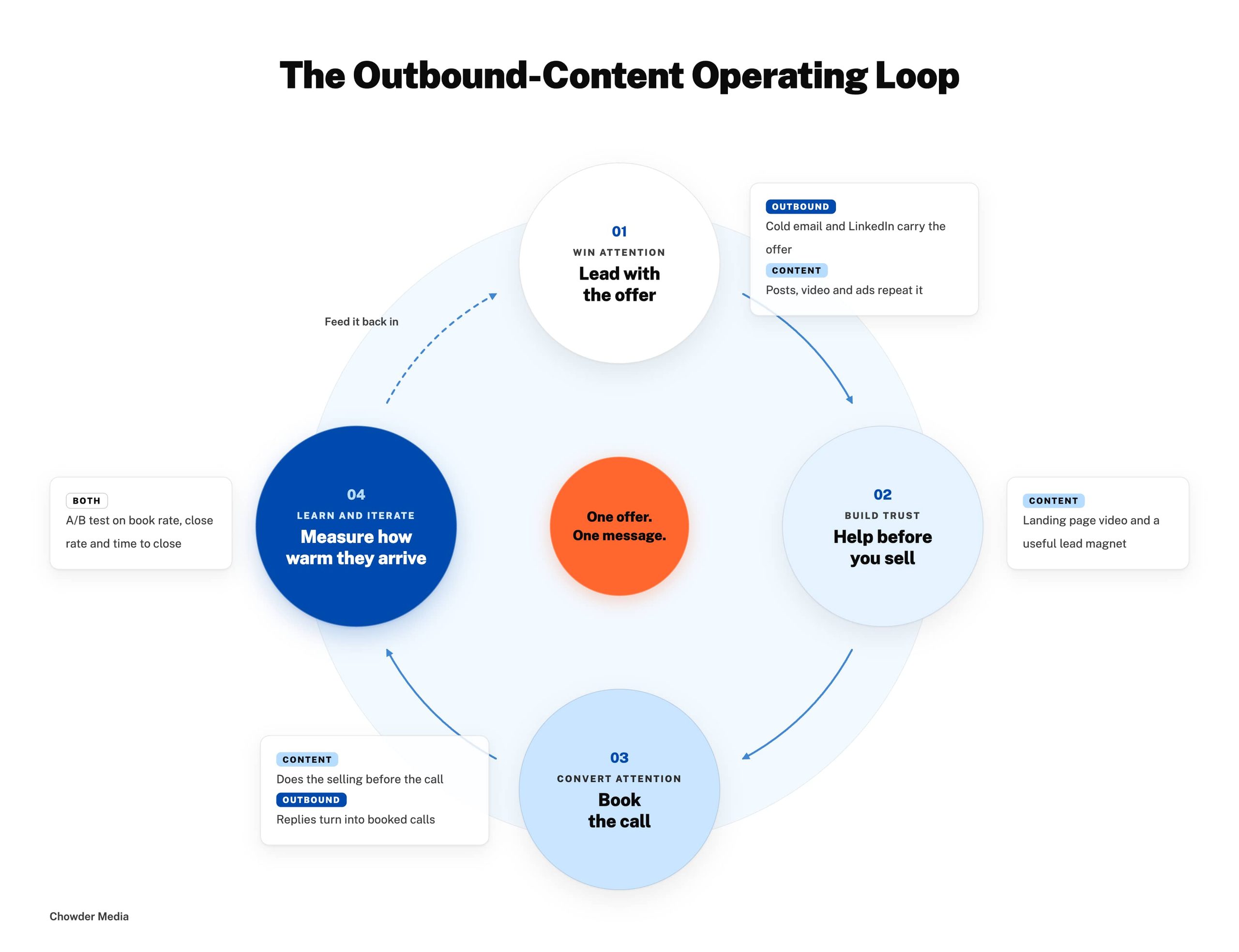
If the goal is to drive demand for your B2B fintech solution, then there are four destinations that your loop must reach.
- Win attention
- Build trust
- Convert attention
- Learn for the next iteration
That means unifying the offer and message in your outbound with the content produced.
Let’s say we’re a B2B payments solution, and our offer is the first 10 transactions fee-free in our outbound. How do we create content around this offer so that our prospects know about it, and choose our solution?
Start by filling the top of the funnel and attracting attention to your offer. Mention the offer in every piece of content you create. In B2B, you can even get away with a video that simply states your offer. This is because buyers are more sophisticated and outcome oriented. Cutting to the chase works.
Strategically, this would look like social content on YouTube and Linkedin, paid advertising, and improving brand discovery on AI search engine optimization (AEO).
After attracting the right attention with the offer, it’s time to convince the prospect to want to book a call with you. Getting there requires trust.
To build that trust, you need to show a clear understanding of your prospect’s pain. Then, you ought to give them something for free that helps soothe their current pain. In marketing speak, we call this a lead magnet. But calling it a lead magnet lowers its actual value. It needs to actually help your prospect and be valuable.
This could be a tool, guide, report, or playbook. At Chowder, we realised that many of our prospects never knew of the demand gaps on their website. So we built a tool that helped them find and fix it. This is in sync with our offer of turning content into demand.
Lastly, after your customer has given their information, either through a lead magnet or a contact form, you need to trace their steps. Ask them what kind of content they consumed. Or if sales is unwilling, you could review sales calls to measure how informed the customer was of the solution before even getting on the call.
The more informed a customer is, the warmer the lead, and the easier the close.
So if the customer demonstrates good knowledge of your solution, then you know that your content marketing is working. If customers come completely cold and uninformed, then work on your content to break that ice.
The beauty of the loop is that it can be continuously improved, as the building blocks of each piece build on each other. While I didn’t mention paid advertising or SEO/ AEO much in this article, they can also integrate into your marketing loop.
To grow in this AI-era, B2B Fintech businesses need an engine, where both outbound and inbound workflows work together to help each other.
Ready to take your B2B Fintech’s growth to the next level?
If your outbound and content marketing is firing but yet the leads and demand generated aren’t up to your expectations, the problem might not be the product or your offer. It could be your strategy and implementation that is holding you back.
At Chowder Media, we do one thing and one thing only. Be the best B2B Content Marketing Agency in Singapore for Fintech companies looking to grow their demand. We achieve this by building an engine that turns content into demand, plugging into your current growth playbook seamlessly. All done-for-you.
If you’re interested, do get in touch.